Posts

Showing posts from December, 2016

Involvement of New Generation Towards Nature Conservation

Image
A student displaying his own art An ounce of practice is worth more than tonnes of preaching (M.K Gandhi).           Some small actions of positive practices are crucial for the well-being of our lonely planet.  Children are considered as assets of our society.  But regional remoteness, the socio-economic condition have created much disparity on balanced and equal development. But to inherit a safe and clean planet to live on there is must necessary to do some action . No matter how bigger is our work but the positive impact of small activity have the capacity to create an ideal environment for living. I in nature awareness with student Student participate one of our nature campaign Manas  In the verse of population explosion, we have not enough resources and provisions for feeding, housing, education and employment to all.  So, natural resources have got tremendous pressure from the human population.  T...

Manas National Park in 2016!

Image
Life is not a  matter of milestones but memories. In the year 2016, we had done lots to conserve the beautiful landscape of  Manas. I would like to look back at briefly gone days of the year 2016.... Unicorns Family at Manas  Dwaimalo with his mother (R17) This was a mixed year for the rhino family of Manas.  During this period, we lost four rhinos out of them two rhinos died due to poaching and two due to natural cause.  We lost Dwaimalo (R17A)  on 22nd April.   Dwaimalo's  mother was killed by poachers just after 20 days of his birth at  Sidhajhar  areas under Bansbari range. Thereafter, we rescued that calf from Kahitama areas of Manas and rehabilitated for about one year with another female rhino calf  (i.e.Purabi).  Rhino 10A with his Mother (R10) Besides our much effort, on  6th May , we lost another orphaned rhino 10A at Bhuyanpara range.  This was first rhino calf born...

Encroachment and conservation in Manas National Park

Image
Men make boundaries and barricades around their physical establishment i.e. home. Unfortunately, we have also demarcated boundaries for wildlife. Wild animals don't know physical boundaries. They are not limited to areas demarcated by us as Protected Areas. As we, humans are more and more limiting their spaces, it has resulted in human-wildlife conflict. These conflicts are not limited to adjacent areas of PAs but now it has spread to areas far away from the protected area. As we are clearing more and forest for our habitat, it has intrigued the extinction of much exotic wildlife from the earth's face. We are also a part of nature and we need to follow natural rules and regulations for the betterment of only living planet in our solar system. Fragile Habitat of  Bhuyanpara, Manas National Park Manas ecosystem provides invaluable service to the betterment of humankind and that yet to analyze properly. Maximum people around the Manas are very co...

Royal Manas National Park, Bhutan

Image
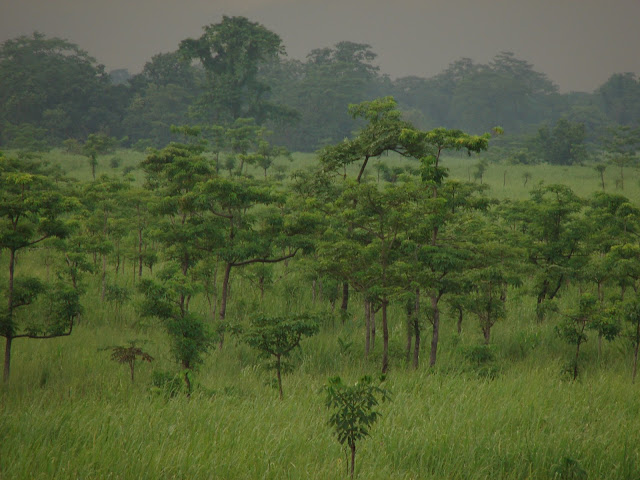
View of Royal Manas National Park from Indian Side Adjacent to our Manas is the Bhutanese counterpart, Royal Manas National Park that shares almost same biodiversity. The beauty of Royal Manas National  Park may thrill of every heart. People who come to visit Manas are usually excited to put their steps in the international boundary of India and Bhutan at the Mathanguri. From  Mathanguri (India side) visitors can watch beautiful landscape of Royal Manas National Park (RMNP). It is the oldest National Park in Bhutan and called "Conservation showpiece of Kingdom". Tall and dense canopy vegetation of  RMNP is rich in wild animal diversity. Location of  RMNP is notably outstanding and forms the cornerstone of protected area network in Bhutan. Further, the national park merges with Manas National Park in India to the south, forming the significant part of Transboundary Manas Conservation Area (TraMCA).The unique landscape of RMNP forms an important natural c...

My Interview on Reintroduction of Greater One-Horned Rhinoceros to Manas National Park

Image
Dear friends, I was interviewed by Sahapedia, an online portal on my view on the reintroduction of Greater One-horned rhinos to Manas National Park. Here is an excerpt of it. Sayantani Chatterjee: How was the reintroduction of the greater one-horned rhinoceros carried out in Manas National Park? Deba Kumar Dutta: The greater one-horned rhinoceros, also known as the Rhinoceros unicornis, constitutes one of the key species as well as a charismatic species of Manas National Park. Manas was once a home to a population of more than 180 rhinos but the entire population was wiped out during the ethnic unrest between 1988 and 2001. The entire rhino population of Manas was rendered locally extinct. Since the early part of 2000, there has been a restoration of peace in the area aided by the formation of the Bodoland Territorial Council (BTC) for local governance. This has led to the restoration of conservation efforts at Manas. For the whole interview, please visit here ....

TraMCA

Image
Nature has no boundaries. The Transboundary Conservation of Manas resemblance with this concept.  The Trans-boundary Manas Conservation Area, or TraMCA, is the initiative towards the conservation of Manas across borders between India and Bhutan.  TraMCA with areas of over 6500 square kilometers is one of the three transboundary landscapes across Eastern Himalayas that connect Bhutan and North-Eastern India.  This transboundary landscape, with unique biological significance, spans from the River Sonkosh, the western boundary of Ripu reserve forest in India to the Jomotsangkha Wildlife Sanctuary in Bhutan to the east. To the south, it extends to the southern boundary of Manas Tiger Reserve in India and to the north, the northern extent of Royal Manas National Park (RMNP) in Bhutan. The area is one of the richest biodiversity zones in entire tropical Asia.  TraMCA Areas of India and Bhutan The Manas National Park (MNP) in India and RMNP Bhutan for...

Winter Chronicles: Embracing the Wilderness of Manas National Park in December

Image
As a devoted conservation biologist, the changing seasons bring a unique rhythm to my life, and there's something magical about the quarter of the year that heralds fall and winter. While many relish the idea of cozying up during this time, my role in wildlife conservation activities often propels me into the heart of nature, leaving the warmth of a comforter a distant luxury. Despite the demands of my profession, I find solace and joy in the wintery mornings spent amidst the captivating landscapes of Manas National Park. The Enchanting Beauty of Manas in December: Winter unveils a different facet of Manas, and December, in particular, holds a special allure. The crisp mornings adorned with dew, the vast expanse of a blue open sky, the carpet of fallen tree leaves, and the golden brown grasslands create a spectacle of extraordinary beauty. Manas sheds its shabby summer look and dons a new avatar, ready to welcome a myriad of visitors. Controlled Grassland Burning: U...

The Bond of Compassion: Alam and Ganga's Story of Survival and Dedication at Manas National Park

Image
Learning to walk on village road The forest is a world of wonders, where humans and wildlife thrive harmoniously. Individuals who embrace the wild as their own are responsible for preserving this balance. Among these stories is that of Ganga, a patrolling elephant at Manas National Park, whose journey is one of resilience and love. Alam. In July 2007, Ganga, then an orphaned elephant calf, was rescued from the raging waters of the Beki River. It was only a few weeks old, and her condition was critical. Forest officials, including Pabitra Das (Forester-I) and Md. Alam (a mahout), stepped in to save her. The Range Officer entrusted Alam with the calf’s care, a task he accepted wholeheartedly. Alam transformed his humble mahout camp into a nurturing sanctuary for Ganga. He gave up his bed to make space for her in his small room. The two shared a simple thatch bed, one side for Alam and the other for Ganga. In accordance with the veterinarian's recommendation, he ...

Come to Unexplored Paradise!

Image
  Entry Point of Manas Manas National Park is situated in the Himalayan foothill zone of north Brahmaputtra valley. Administratively, it comes under the jurisdiction of Baksa district of Assam. The park is the only protected area in India with five important conservation status, a tiger reserve, a national park, a biosphere reserve, an elephant reserve and a World Heritage Site. So, no need to babble about its flora and wildlife. It is also an Important Bird Area where near about 500 birds, both migratory and resident, can be seen.   How to get there? The nearest airport to reach there is Guwahati. Manas is accessible from Guwahati by train and road. The nearest prominent town and railway station is  Barpeta Road. From there, it took only half an hour by road to reach Bansbari, the central entry point to the wild. Park Avenue of Manas Where to stay? So, where to stay once you reach there? There are a few resorts, namely MEWS, Birina, Bluehills ...